
Best storage boxes
Best Card Storage Boxes
The cheapest cost per card in the hobby — and the capacity maths nobody explains.
See all 6 picks →
Stage 5 of the collection
The collection is growing. Keep it findable, flat and safe.
Disclosure: Slab & Stack is funded by affiliate commission. If you buy through a link on this page we may earn a commission at no extra cost to you, and that never changes which product we put first. How we pick · Full disclosure
Storage stops being about protection and starts being about retrieval somewhere around the two-thousand-card mark. Before that, any box works. After that, the question is no longer whether the cards are safe — it is whether you can find one card in under a minute without unloading a row, and whether you can tell what you own without opening anything.
A box is volume. It is the cheapest cost per card by a wide margin, it stacks, and with tabbed dividers it is searchable. It is also the only sensible home for anything in a toploader. A binder is display and completion. It shows a set at a glance, it is the right format for a player collection or a run you are building, and it is a worse format for bulk in every respect. Most collections need both, used for different things — the long version is in boxes vs binders.
Manufacturer capacities assume bare cards. BCW publishes about 700 standard 20pt cards for its 800-count box, and that figure is honest for loose cards. Put those cards in penny sleeves and 35pt toploaders and the same box holds roughly a third of that, because a loaded holder is around three times the thickness of a bare card. Plan on the loaded figure, not the printed one — the arithmetic is laid out in card box count sizes explained.
Two details decide whether a binder protects a collection or slowly damages it. The first is side-loading versus top-loading: a top-loading page sheds cards the moment the binder is upended, and a side-loading page does not. The second is material: pages must be acid-free and PVC-free, because PVC softeners migrate into card surfaces over years. Everything on best 9-pocket pages meets the material requirement, which is the floor rather than a feature.
Thick cards do not belong in nine-pocket pages at all. A relic wedged into a standard pocket is a card under constant pressure — four-pocket pages exist precisely for this, and a thick card in a binder with no alternative should be in a box instead.
Cardboard does nothing against humidity, and most collections live in exactly the two places that have humidity problems: a garage and a basement. Stable room temperature, low humidity, no direct light, and nothing stacked heavily enough to press. For the handful of items whose loss would genuinely hurt, a rated fireproof box is the only product category here that makes a published safety claim — and read the rating, because fire ratings are not water ratings.
Once the physical order exists, the digital record is the obvious next step — that is scanning and tracking.
Each list leads with the one to buy, and each tile links straight to the live listing for its top pick.
Best storage boxes
The cheapest cost per card in the hobby — and the capacity maths nobody explains.
See all 6 picks →

Best binders
Two features decide whether a binder protects a collection or slowly damages it.
See all 5 picks →
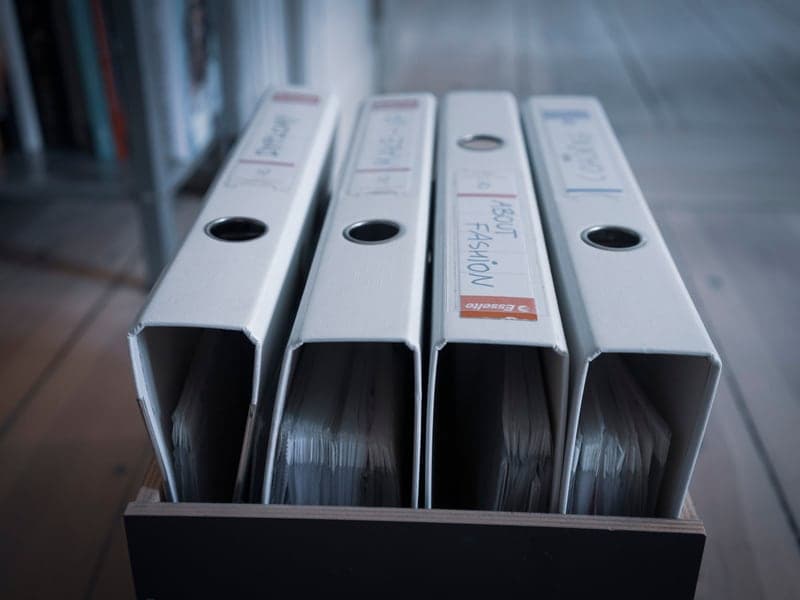
Best binder pages
Acid-free and PVC-free is the floor, not a feature. Here is what separates the rest.
See all 4 picks →
Best thick-card binder format
A thin category with one workable answer, and a better alternative most of the time.
See all 4 picks →

Best bulk storage
For the thousands of cards that are not worth individual protection, but are worth keeping.
See all 5 picks →
Best fireproof storage
The only product category here that makes a published safety claim. Read the rating.
See all 4 picks →
Best dividers
The cheapest thing you can buy that changes how a collection works.
See all 4 picks →
The questions that decide a purchase before you get to the product list.
Reference
The printed number is for bare cards. Here is what you actually get.
Head to head
Not a rivalry. A division of labor that most collections get wrong in one direction.
Head to head
One breathes, one seals. In a damp room, that difference cuts both ways.
Guide
A system that takes thirty seconds at a time instead of an afternoon once a year.
Guide
Two passes beat one. Here is the method that works on a thousand cards.
Guide
The decision that matters most is free: where the boxes live.