Storage & Organization
Best Humidity for Card Storage
About 35% relative humidity, cool, dark - and stable matters more than exact.
By Brijon M. · Published October 17, 2026 · Last updated October 17, 2026
Disclosure: Slab & Stack is funded by affiliate commission. If you buy through a link on this page we may earn a commission at no extra cost to you, and that never changes which product we put first. How we pick · Full disclosure
The short answer
Aim for about 35% relative humidity at room temperature or below, and prioritize stability over precision
The Library of Congress recommendation for paper-based collections is "a cool (room temperature or below), relatively dry (about 35% relative humidity), clean, and stable environment" with "minimal exposure to all kinds of light". Cards are paper, so that is the benchmark worth using. The practical advice follows from the word stable: an interior closet that sits at a steady 45% is better for cardboard than a garage that swings between 25% and 70% across a year, even though the garage hits 35% twice on the way through.
Store cards at about 35% relative humidity, at room temperature or below, in a clean and stable environment with minimal light. That is the Library of Congress recommendation for paper-based collections, and since a trading card is coated paper stock, it is the most authoritative number available for the question. The institution's own wording is "a cool (room temperature or below), relatively dry (about 35% relative humidity), clean, and stable environment".
The word to notice in that sentence is stable. Hitting 35% exactly is neither necessary nor achievable in a normal house, and chasing it is the wrong goal. What damages cardboard is cycling — absorbing moisture in a humid month, releasing it in a dry one, repeatedly — because each cycle swells and shrinks the fibres. A steady 45% is kinder to a collection than an average of 35% achieved by swinging between 25% and 65%.
What humidity actually does to a card
| Condition | What happens | Where you see it |
|---|---|---|
| Too damp, sustained | Fibres swell; edges soften; surfaces can bloom or stick | Soft corners and edges — graded as wear |
| Too damp then dry, cycling | Repeated swelling and shrinking warps the card | Cards that will not sit flat in a holder |
| Very dry, sustained | Stock becomes brittle; coated surfaces crack more easily | Chipping along edges and at corners on handling |
| Damp plus warm | Conditions favorable to mold on paper | Spotting and staining, usually unrecoverable |
| Stable and moderate | Nothing | The goal |
Mechanisms are general paper-conservation behavior. The specific target figures come from the Library of Congress guidance for paper collections, cited below.
None of these failure modes is dramatic, which is why they are easy to let happen. A card does not visibly rot; it goes soft at the corners over a couple of years in a garage, and the next person to look at it reads that as handling wear. For anything you intend to have graded, that quiet degradation is the whole stake — the criteria graders score are exactly the ones humidity attacks. See how to store cards before grading.
Where to put the boxes
The Library of Congress is specific about locations as well as numbers, advising against "attics, basements, and other locations with high risk of leaks and environmental extremes". In a house, that rules out most of the places people naturally store boxes.
- Good: an interior closet, a shelf in a lived-in room, under a bed on an interior wall. Spaces you heat and cool are already stable because you keep them comfortable.
- Poor: the garage. Uninsulated, unconditioned, and it tracks the outside weather with a lag.
- Poor: the loft or attic. The widest temperature swing in the building, and heat accelerates everything.
- Poor: a basement. Usually the dampest space in the house, and the one with leak risk.
- Poor: against an exterior wall or a sunlit window, even indoors. Both create a local microclimate and light exposure.
Quick picks
| # | Product | Best for | Price |
|---|---|---|---|
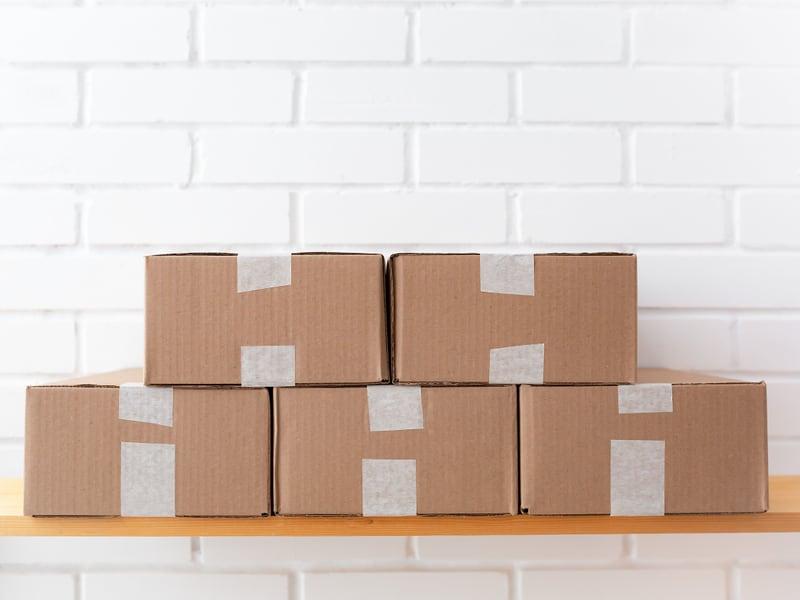
| 1 | B BCW 800-Count Cardboard Storage Box White corrugated at 200 lb test, stacking without sagging. In a stable interior space, plain cardboard is all a collection needs, and it is the cheapest cost per card stored of any format. The default box for a controlled room | The default raw-card box | Check price on Amazon |
| 2 | Y YYDS 4400-Count Card Storage Boxes Water-resistant construction per the manufacturer, which is the reason to choose these over plain cardboard for anything that has to live in a basement. Water resistant is not waterproof, and the finish does not control humidity. Best where damp is a real risk | Water-resistant bulk storage | Check price on Amazon |
| 3 | S SentrySafe Fireproof Chest A published fire rating, which card-storage products never carry, and a lock. Measure the interior against slab height before buying — these are sized for documents. Best for the small number of slabs you would mourn | The slabs you would actually mourn | Check price on Amazon |
| 4 | B BCW Resealable Team Bags A resealable acid-free bag around a sleeved and held card costs pennies and gives each card its own small buffered envelope. It is the step most collectors skip and the cheapest one available. The cheap moisture and dust barrier | Sealing a sleeved and held card | Check price on Amazon |
#ad We earn a commission if you buy through these links, at no cost to you. Prices move constantly, so we link to the live listing instead of printing a number that would be wrong next week. How we are funded.
1. The default box for a controlled room
BCW 800-Count Cardboard Storage Box
BCW · The default raw-card box
White corrugated, 200 lb test, and the box the hobby measures storage in. Buy these in multipacks and label them; the count on the lid is the only organization system that survives contact with a growing collection.
Why it takes this slot: White corrugated at 200 lb test, stacking without sagging. In a stable interior space, plain cardboard is all a collection needs, and it is the cheapest cost per card stored of any format.
- Stated capacity
- About 700 standard 20pt cards, or about 1,140 gaming cards
- Construction
- White corrugated paper, 200 lb test
- Format
- Two-piece box with lid
What it does well
- The published test strength is real — these stack without sagging
- Cheapest cost per card stored of any format
- Sold in multipacks, so a restock is one order
Where it falls short
- The nominal count assumes bare cards, not sleeved or held ones
- Cardboard gives you nothing against humidity
#ad We link to the listing rather than printing a price that would be wrong next week. How we are funded
2. Best where damp is a real risk
YYDS 4400-Count Card Storage Boxes
YYDS · Water-resistant bulk storage
High-capacity boxes with a water-resistant finish. The finish is the reason to pick these over plain cardboard for anything stored in a garage or basement.
Why it takes this slot: Water-resistant construction per the manufacturer, which is the reason to choose these over plain cardboard for anything that has to live in a basement. Water resistant is not waterproof, and the finish does not control humidity.
- Stated capacity
- 4,400 cards per box
- Feature
- Water-resistant construction per the manufacturer
- Pack size
- 4-pack
What it does well
- A water-resistant shell is a genuine advantage in a basement
- Very low cost per card stored
Where it falls short
- Water resistant is not waterproof
- Too heavy to move when full
#ad We link to the listing rather than printing a price that would be wrong next week. How we are funded
3. Best for the small number of slabs you would mourn
SentrySafe Fireproof Chest
SentrySafe · The slabs you would actually mourn
A rated fireproof chest is the only honest answer to protecting a small number of high-value slabs at home. Read the published rating and buy for the size of the slabs, not the card count.
Why it takes this slot: A published fire rating, which card-storage products never carry, and a lock. Measure the interior against slab height before buying — these are sized for documents.
- Purpose
- Fire-resistant document and valuables chest
- Rating
- Fire rating published per model by the manufacturer
- Note
- Ratings are time-and-temperature specific — check the model
What it does well
- A published fire rating, which card-storage products never carry
- Also locks, which handles the mundane risk
Where it falls short
- Interiors are sized for documents, not slabs — measure before buying
- Fire ratings are not waterproof ratings; check both
- Heavy, and expensive per card stored
#ad We link to the listing rather than printing a price that would be wrong next week. How we are funded
4. The cheap moisture and dust barrier
BCW Resealable Team Bags
BCW · Sealing a sleeved and held card
The cheap step everybody skips. A resealable bag around a sleeved card in a holder keeps dust and humidity off it and keeps lots together in a box.
Why it takes this slot: A resealable acid-free bag around a sleeved and held card costs pennies and gives each card its own small buffered envelope. It is the step most collectors skip and the cheapest one available.
- Format
- Resealable polypropylene bag
- Material
- Acid-free, PVC-free
- Pack size
- 100 count
What it does well
- Pennies per card for a real dust and moisture barrier
- Keeps a lot or a team set together without rubber bands
- Resealable, so it survives repeated handling
Where it falls short
- One more thing to open when you want the card
- Does nothing about physical impact
#ad We link to the listing rather than printing a price that would be wrong next week. How we are funded
Measuring before you intervene
Buy a cheap hygrometer and leave it with the collection for a month before changing anything. Most people's assumption about their own house is wrong in one direction or the other, and an inexpensive reading taken weekly tells you whether you have a problem, a seasonal problem, or no problem at all.
If the reading sits between roughly 35% and 50% year-round, you are done — no silica gel, no dehumidifier, no project. If it regularly exceeds 60%, or regularly falls below 25%, that is worth acting on. And if it moves 30 points between summer and winter, the fix is the location rather than any product.
What the enclosures contribute
Nothing you put a card in controls humidity, and it is worth being clear about that, because packaging is often sold as if it did. What enclosures do is buffer and slow the exchange — a sleeved card inside a holder inside a bag inside a closed box responds to a change in room humidity over days rather than hours, which blunts short swings.
They also deal with the risks that are not humidity: dust, light, handling and surface contact. The material point matters here. Acid-free and PVC-free is the specification to look for, because old PVC sleeves degrade over years and can mark a card — and the Library of Congress guidance on enclosures is the same in principle, recommending "acid- and lignin-free folders, mats, and document boxes". The sleeve-level comparison is in penny sleeves vs premium sleeves.
Slabs are not exempt
A graded card sits inside a sealed case, which protects it from handling and dust and does not make it immune to its environment. Slabs are not hermetic, extremes of heat can stress the case, and the label inside is paper. The practical consequence is that a box of slabs in a loft is still a bad idea, even though each card is encapsulated.
The additional slab-specific risk is physical rather than atmospheric: cases scratch against each other. That is what how to store graded cards and best slab storage boxes are for.
A working setup
- Put a hygrometer with the collection and read it weekly for a month before buying anything.
- Move the boxes into conditioned interior space — a closet or a lived-in room, away from exterior walls and windows.
- Sleeve and hold anything you care about, and bag the cards that matter most for a per-card buffer.
- Use water-resistant boxes only where damp is a genuine risk, and understand that resistance is not control.
- If the room reads above 60% consistently, condition the room rather than the box.
- Keep the collection dark. Light damage is cumulative, irreversible and completely free to avoid.
That is the whole program, and the striking thing about it is how little of it costs money. The expensive-looking answers — dehumidifiers, sealed containers, climate-controlled units — are mostly solutions to having stored cards in the wrong room. Move the boxes first. The broader method is in how to store sports cards long term, the box formats in best card storage boxes, the vintage-specific case in how to store vintage baseball cards, and the fire question in best fireproof card storage.
Common questions
What humidity should sports cards be stored at?
Is 50% humidity too high for card storage?
Should I put silica gel in my card boxes?
Can I store cards in a garage or basement?
Does humidity affect graded cards in slabs?
How do I know if my storage humidity is a problem?
Back to Storage & Organization.
Sources
About the author
Brijon M. is the hands-on owner behind MadGrey LLC and the person who writes and maintains every page on Slab & Stack. He buys supplies in bulk, submits cards for grading, and keeps this site's recommendations tied to what a working collection actually needs.
Brijon M. · Owner, MadGrey LLC · Read the full bio
Read next
guide
How to Store Sports Cards Long Term
The decision that matters most is free: where the boxes live.
Picks
Best Card Storage Boxes
The cheapest cost per card in the hobby — and the capacity maths nobody explains.
guide
How to Store Vintage Baseball Cards
Old cardboard fails differently. Store it for the paper, not for the plastic.
Picks
Best Fireproof Card Storage
The only product category here that makes a published safety claim. Read the rating.

guide
How to Store Cards Before Grading
Sleeve, semi-rigid, flat, dry, dark. The waiting is where grades get lost.